REUBEN WU
Earth, Reconsidered
The Photographic Language of Reuben Wu
Written by Scott Reither
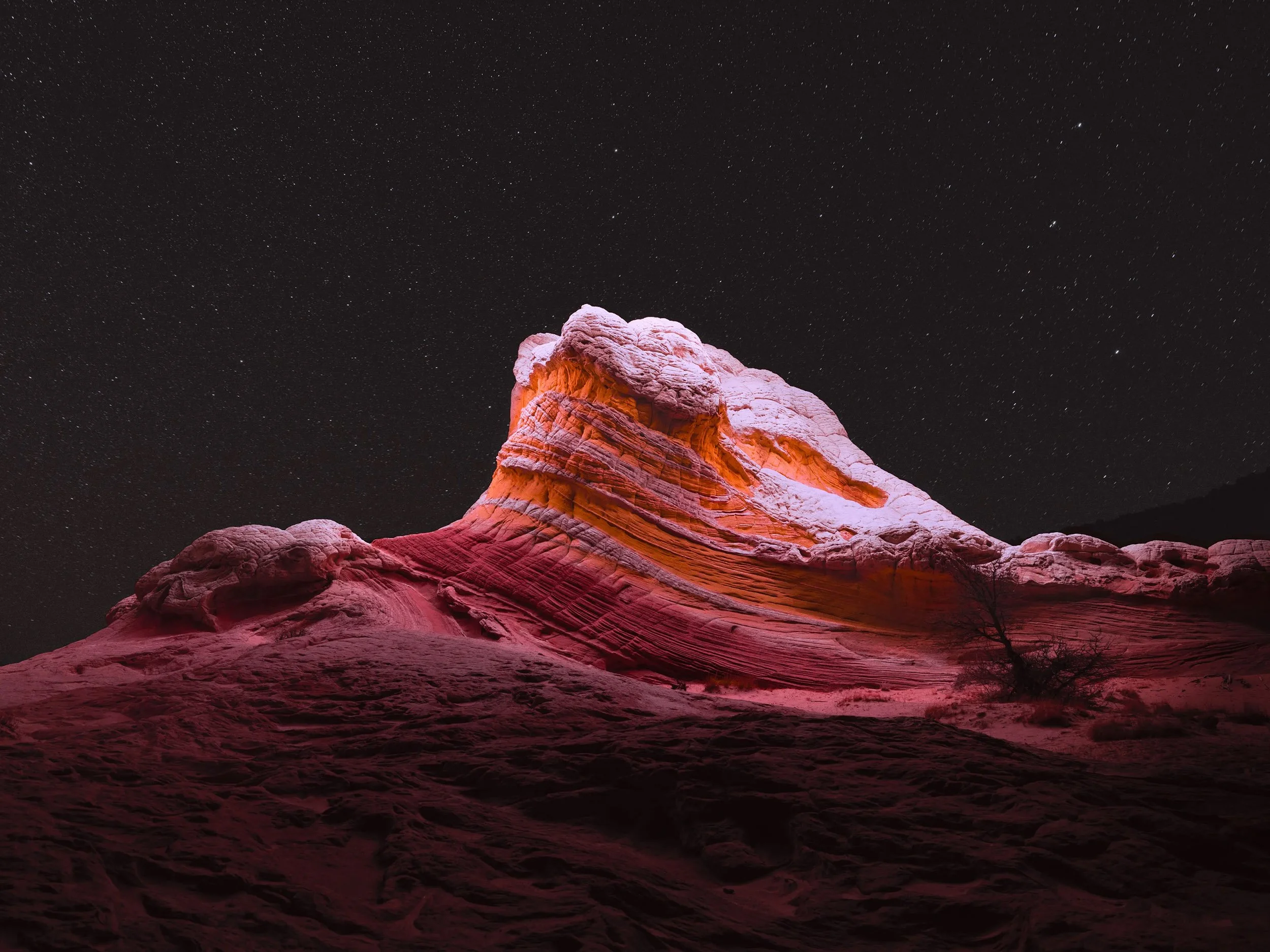
There is a quiet voltage inside a Reuben Wu landscape — a kind of charged stillness, as if the world has slipped a fraction out of phase and revealed a version of itself we weren’t meant to see. Mountains glow as though lit from the inside. Desert plateaus fall into impossible gradients. Glacial surfaces catch light in ways that feel less like reflection and more like memory.
To stand in front of one of these images is to feel reality tilt. Not enough to disorient, but enough to make you pause. Enough to introduce doubt into what you thought you understood about light, distance, atmosphere, and the limits of the familiar.
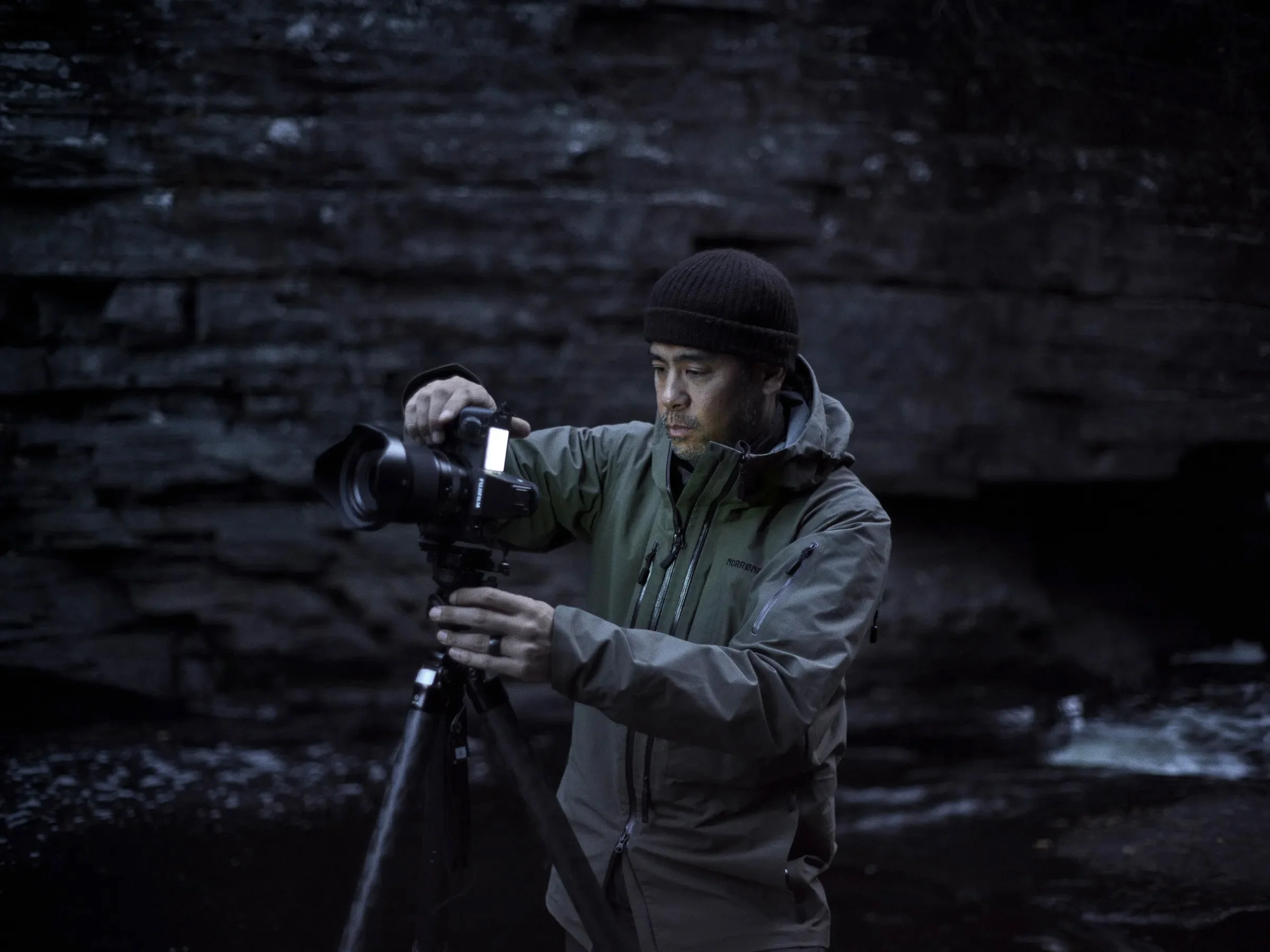
Nothing in these images is incidental. The otherworldly mood doesn’t come from spectacle or invention; it comes from the way Reuben studies a landscape before ever trying to transform it. He watches how light moves across a ridge, how shadow settles into stone, how a place changes as night begins to take hold. This attention becomes the foundation — the quiet work beneath the work.
From there, he approaches the landscape by working with time as much as terrain — layering perspective and intention with quiet precision. His photographs don’t depart from the real world. They reveal a harmony that already exists within it.
What Changes First
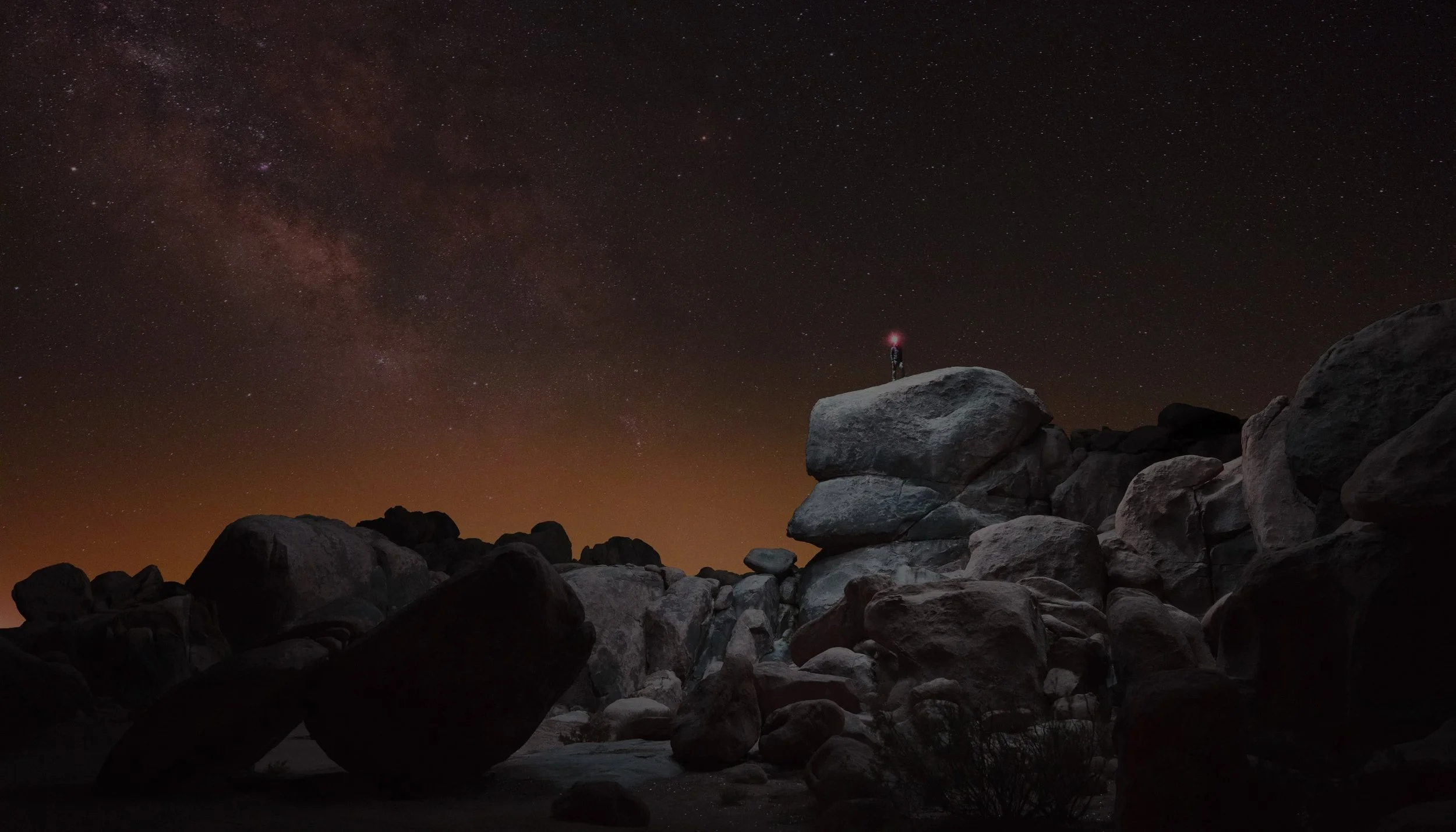
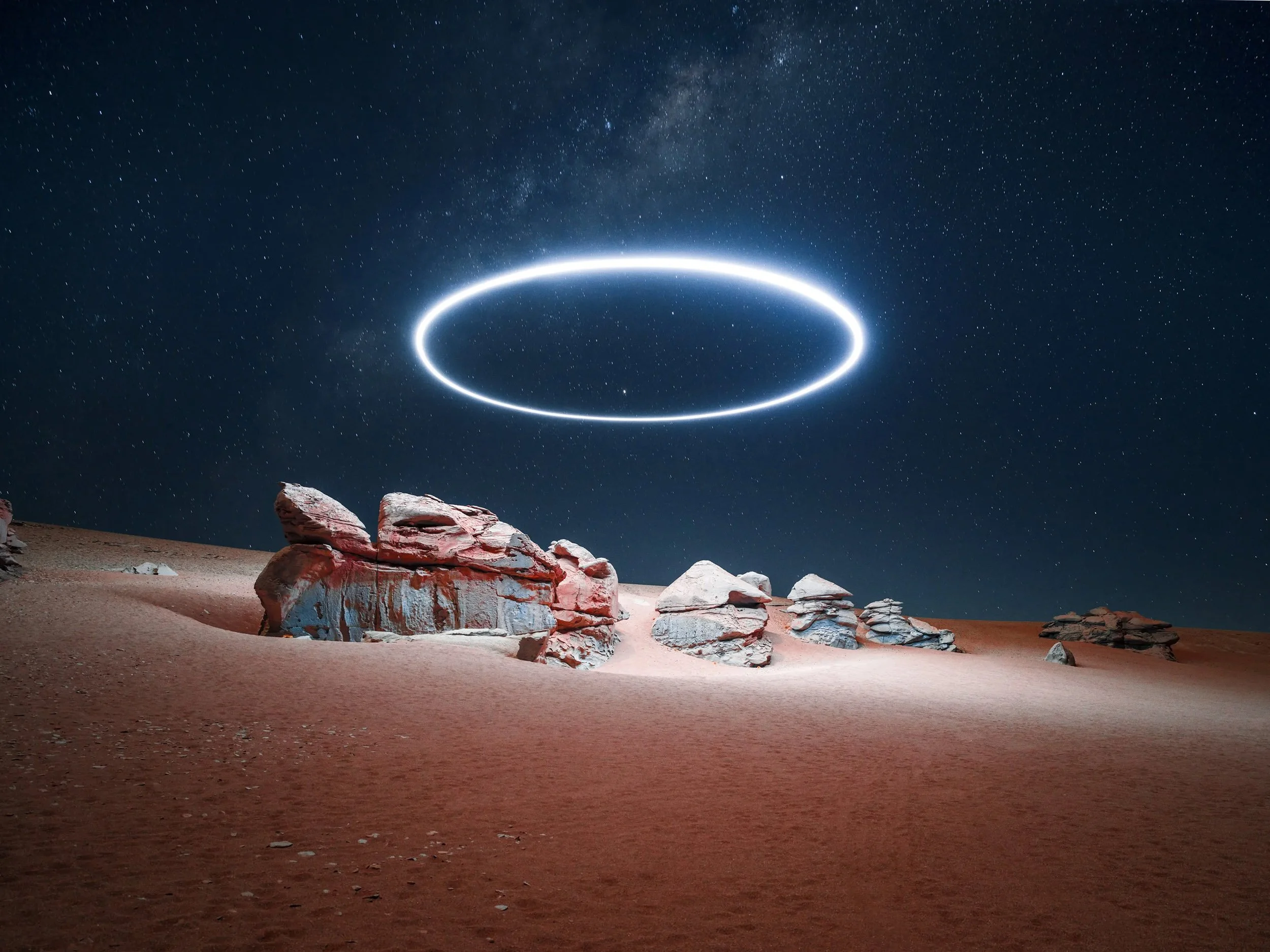
Revelation arrived differently in the early years. It announced itself with force, as if the landscape wanted to be unmistakably known. Reuben often returns to a story from the Trona Pinnacles — those alien spires rising out of the California desert. He was there at night, already tuned to the quiet of the place, when a truck crested a distant ridge and swept its headlights across the land. For a moment, the pinnacles ignited. Stone turned sculptural. Shadow behaved like architecture. The entire landscape shifted into something he hadn’t imagined moments before.
For many artists, a moment like that becomes the whole story — the lightning bolt, the singular event, the mythology of “how it all began.” But what interests me, listening to Reuben speak about it now, is not the drama itself, but the shift in understanding that followed. Trona wasn’t just a lucky break. It revealed how many possibilities go unnoticed unless someone is prepared to see them.
When he talks about those early breakthroughs now, there’s no trace of mythology in the way he frames them. Not dismissively, but with the calm of someone who knows that revelation is less about the spectacular moment and more about the mindset that allows it to be recognized. “Those moments are still there,” he says. “But I’m more attuned to recognizing them. They’ve become more subtle.”
This is where the evolution begins.
Back then, revelation felt like intrusion — sudden, undeniable, impossible to ignore. Today, it arrives like weather. A shift in tone rather than a bolt of lightning. A feeling at the edge of perception. If the drama of Trona cracked something open for him, the years that followed taught him how to sense the opening long before it appears.
I recognize that distinction. Photographers talk all the time about “getting lucky” with conditions, but luck rarely belongs to those moving too quickly to notice what the landscape is offering. There’s a discipline to paying attention, a kind of interior stillness that sharpens one’s awareness of possibility. Reuben’s work operates inside that stillness.
“Preparation enables serendipity,” he says — and the line lands differently once you’ve heard him describe his process. It’s not a slogan. It’s how he navigates the world. The more he understands a place — how light moves through it, how time reshapes it, how atmosphere holds itself at night — the more attuned he becomes to the near-invisible cues that signal when a shift is about to happen.
The world revealing a narrow frequency that only becomes audible when someone is quiet enough — and attentive enough — to receive it.
Revelation for Reuben is no longer an interruption.
It’s a dialogue.
A conversation between the landscape and the mind shaping it.
The Outsider’s Vantage
Before the luminous landscapes, before the engineered light and remote expeditions, there was a quieter beginning.
Reuben grew up in Liverpool as a Chinese kid in a predominantly white city, always aware of being an outsider — close enough to observe everything, but rarely fully inside it. That vantage point shaped him long before he understood how it would matter.
Learning to read a room before entering it, noticing atmosphere before action, watching how people occupy space when you aren’t entirely sure where you belong — this wasn’t framed by him as hardship or exclusion, but as the condition that formed how he learned to pay attention. Observation wasn’t a strategy. It was instinct.
That instinct — to study before stepping forward, to observe from the edges — became the foundation for the way he sees now. You can hear it in the way he talks about landscapes, attentive to the quiet cues that reveal a place’s character long before the camera ever comes out. The patience in his descriptions isn’t something he adopted later; it’s something he carried forward. For him, the act of looking has always moved at its own deliberate pace.
This is why his photographs don’t read as literal records. They aren’t concerned with documenting a location so much as exploring what a place might become. They carry the sensibility of someone attuned to the quieter parts of a landscape, someone who notices what sits just beyond the obvious. His landscapes may be real, but the atmosphere within them reflects the perspective of someone who learned early on to stand just outside the frame.
“The more I experiment with light and perspective,” he says, “the more I see potential transformations everywhere. It's become almost compulsive — this constant mental process of reimagining what I encounter. The work and the way of seeing have evolved together, each informing and deepening the other.”
Listening to him, it becomes clear that photography didn’t give him this sensitivity. It refined it. The camera became the instrument that allowed an interior way of seeing — shaped by distance, sharpened by years of quiet observation — to take visual form.
There’s a direct line from the child in Liverpool, watching from the margins, to the artist who now reads vast, remote terrain with the same intuitive precision. What he brings to a landscape isn’t just technique or technology.
It’s a lifetime of learning how to see differently.
Where Light Becomes Language
Every encounter with Reuben’s work invites a choice: you can focus on the mechanics of how the light moves, or you can sit with the deeper question of why the light is there at all. Only one of those paths leads to the heart of what he’s doing.
For most photographers, the instinct is obvious. The drones, the engineered illumination, the choreography of those impossible arcs — it’s easy to want the blueprint. I understand that impulse. I’ve felt it myself. But with Reuben, chasing the “how” feels like the wrong place to begin. It reduces the work to a puzzle — treating mystery as something to be decoded rather than experienced. And in this case, mystery is part of the offering.
There’s a simple truth to his images: understanding every mechanism behind them would only make them smaller. The spell isn’t in the equipment. It’s in the feeling the work evokes — that quiet moment when your mind recognizes a landscape, but your body registers something far more unfamiliar. Art lives in the feeling-body, not the thinking-mind alone. And what Reuben creates belongs firmly in that territory.
In our exchange, he shared something that stayed with me: “Ideas take shape through making.” That simple line opens a window into his approach. He isn’t using light to show you what he already knows. He’s using light to discover what the landscape can become. His illumination doesn’t sit on top of the terrain; it moves through it, shaping meaning, mood, and the emotional temperature of the scene.
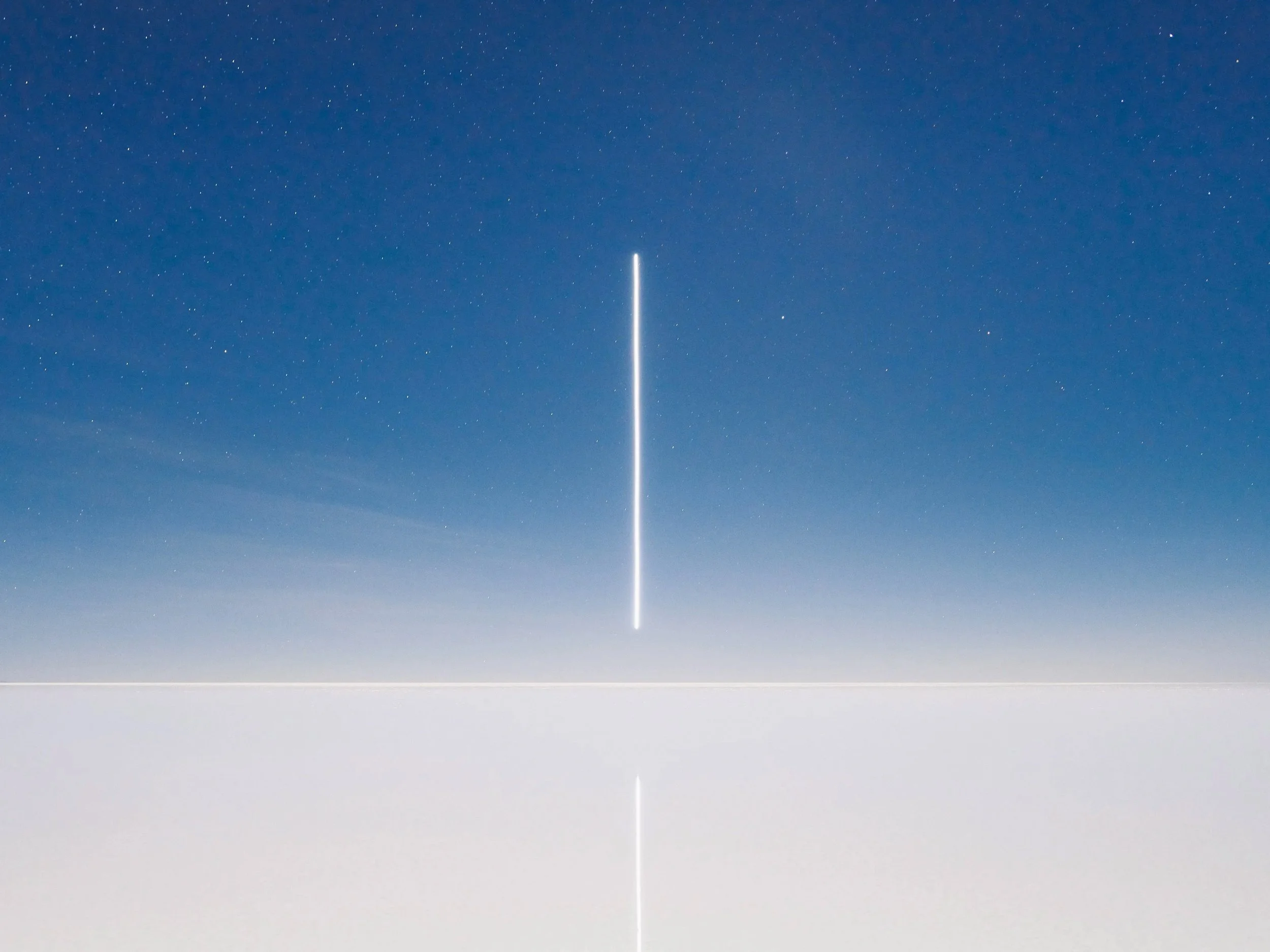
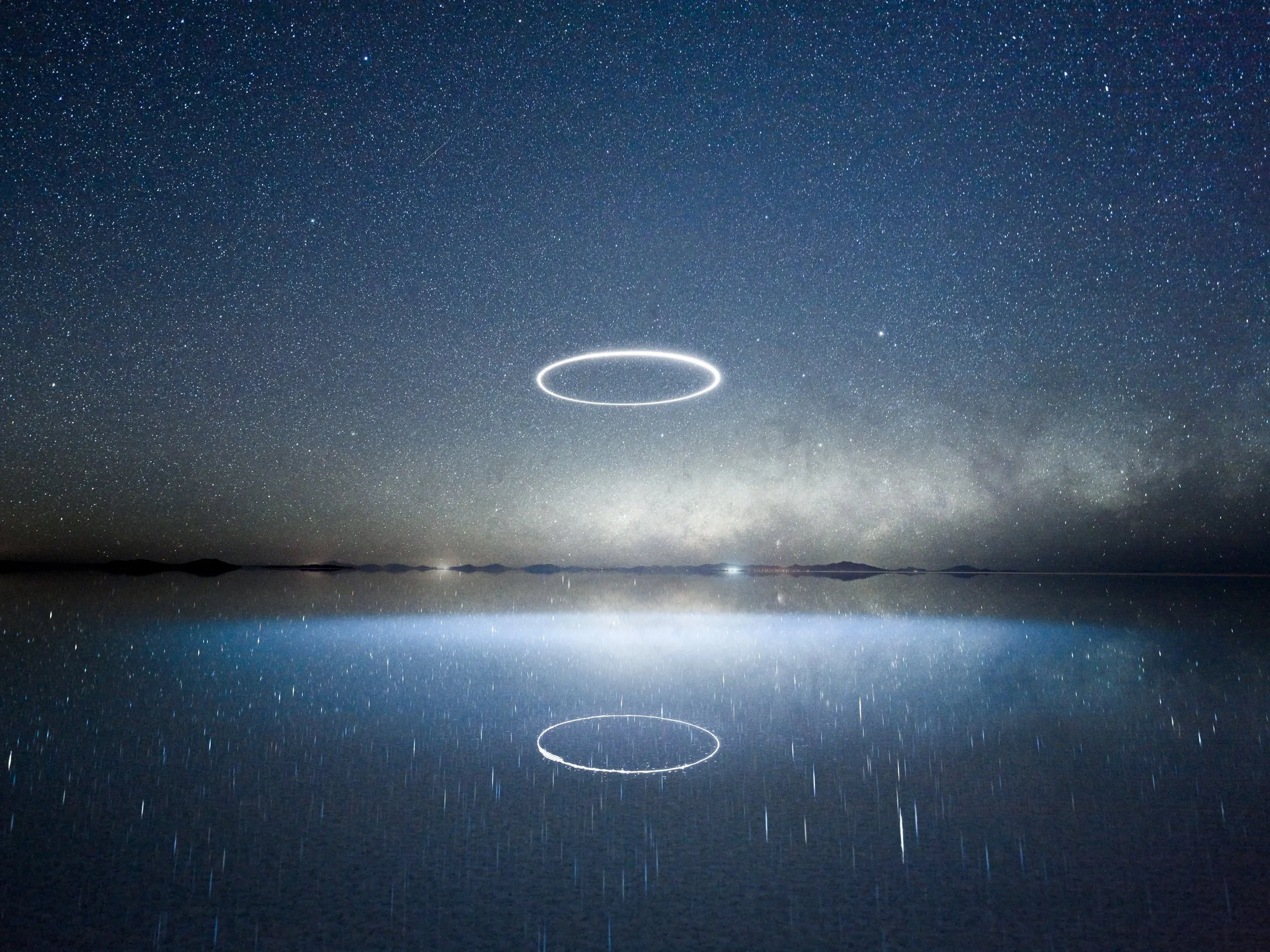
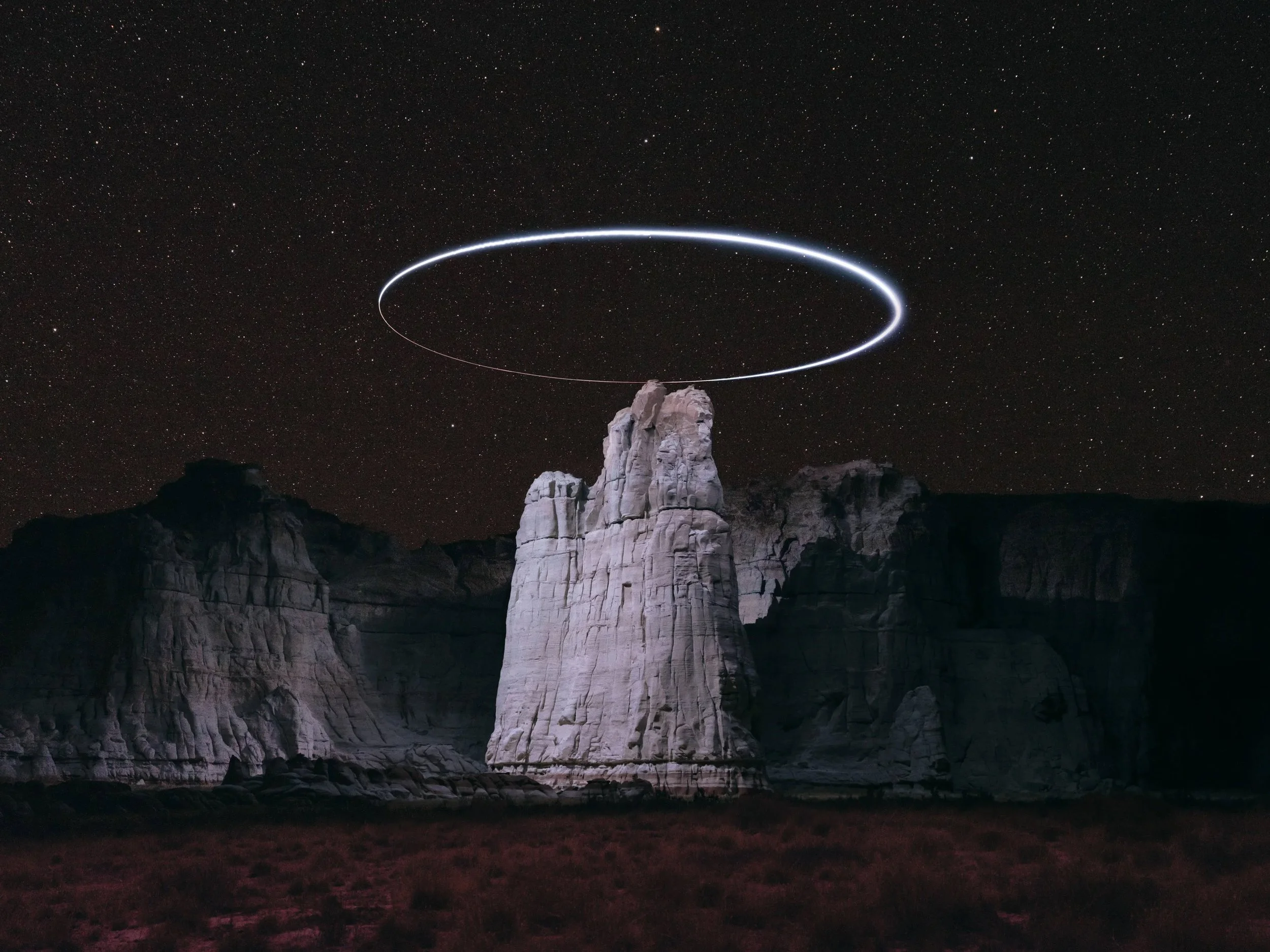
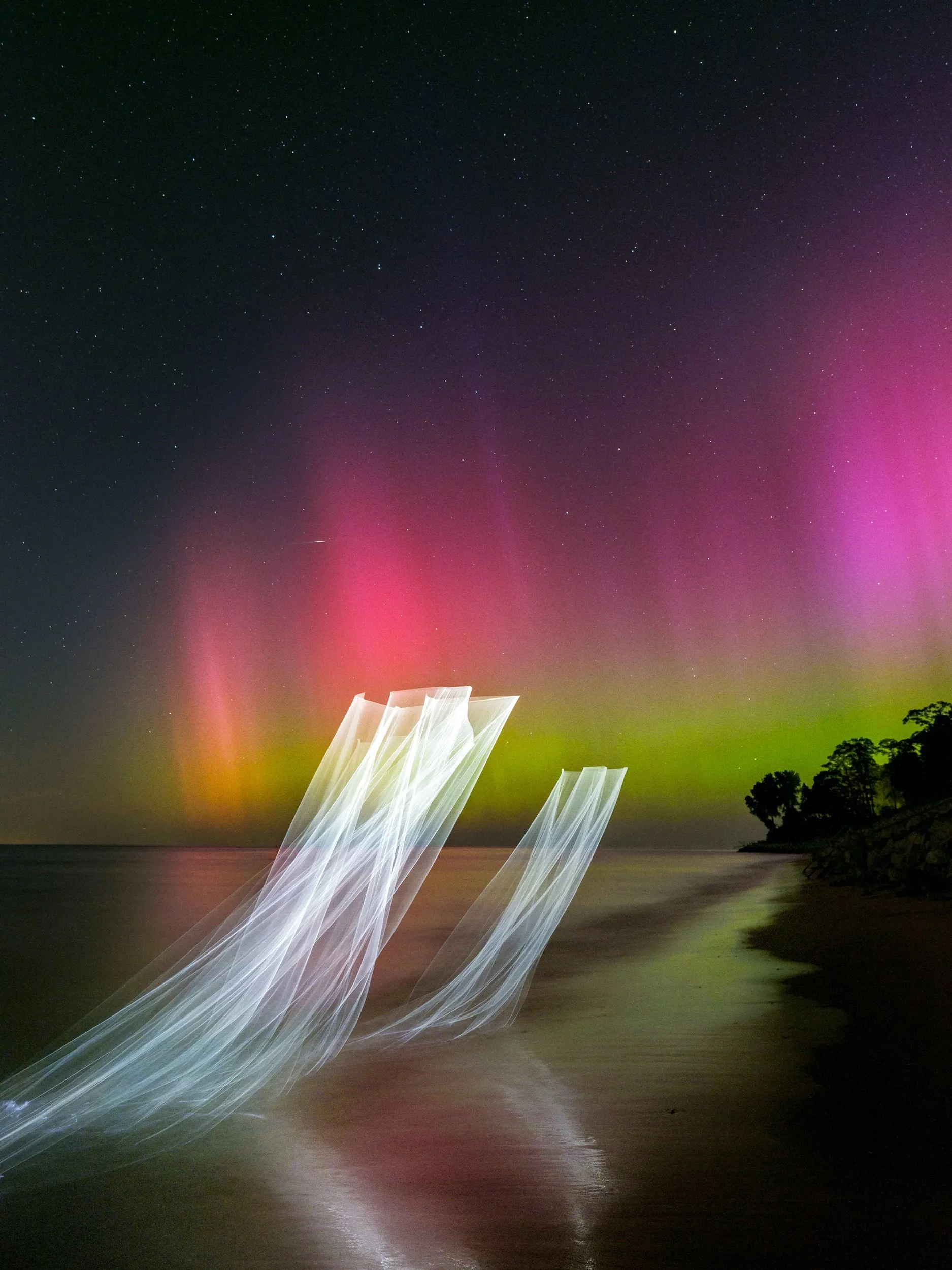
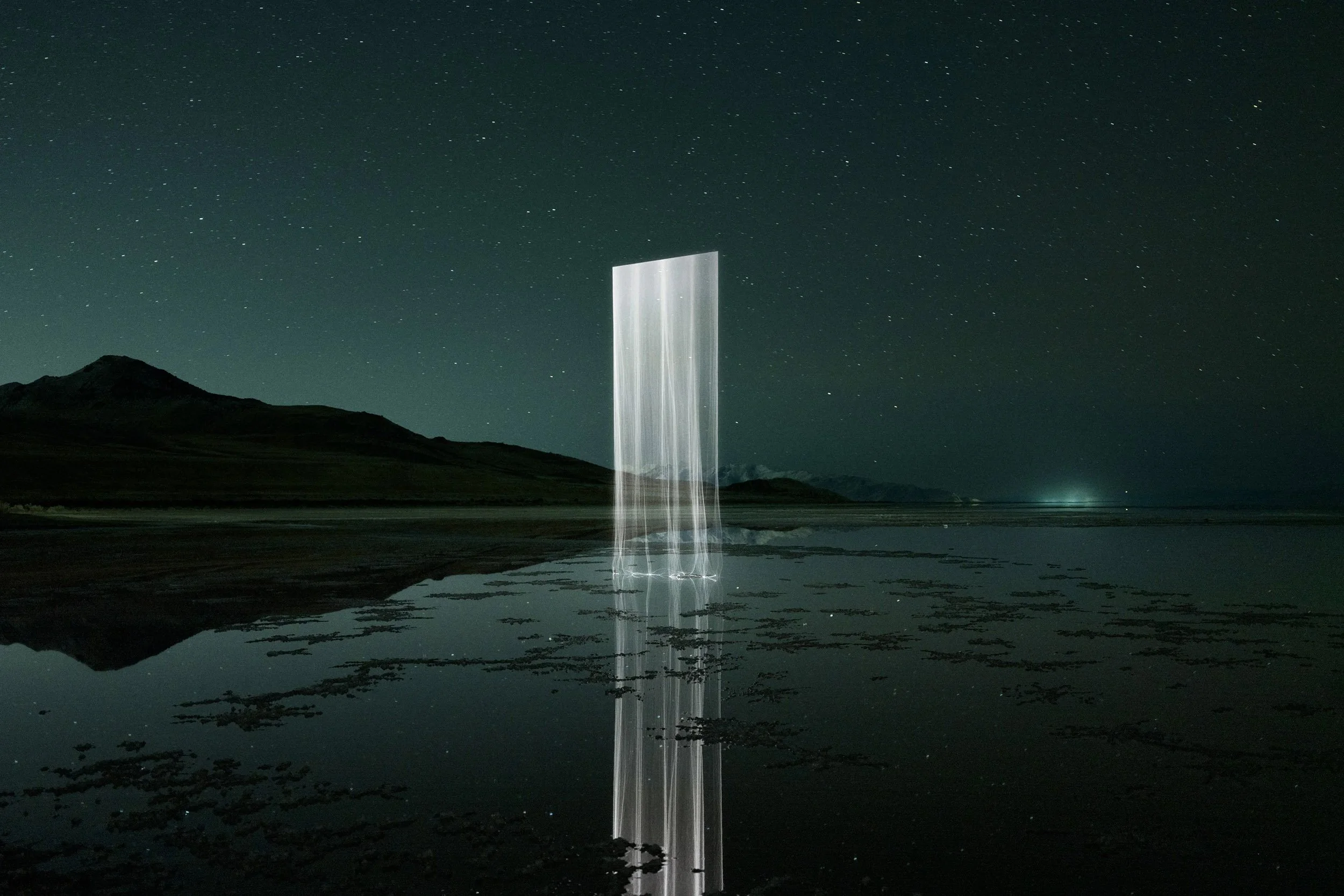
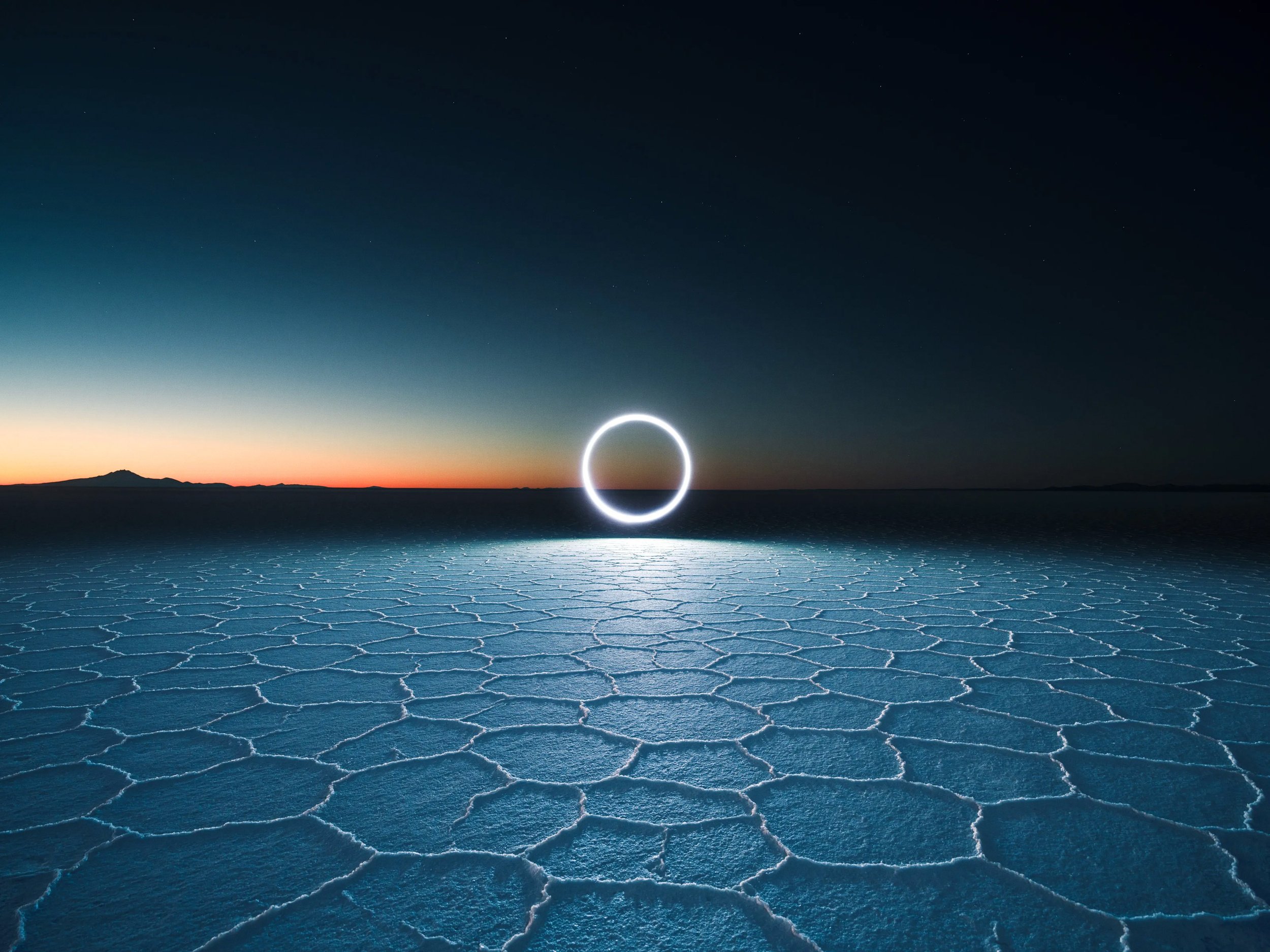
In one image, a single sweep of light anchors the viewer within the vastness of a salt flat. In another, a hovering line introduces a sense of tension, as if the world is holding its breath. Elsewhere, the gesture softens, brushing the edge of a ridge the way a hand might trace the spine of a familiar object. These decisions read less like technique and more like phrasing — the difference between speaking and speaking with intention.
You can sense the intelligence in the way he introduces these gestures. Each line, plane, or glimmer of light is a decision about how the landscape wants to be understood. Horizontal movement can steady the frame; a rising path can expand it; a suspended mark can draw you into the emptiness between forms. Light becomes a kind of architecture — not building structures, but revealing the structure already there, waiting.
Across his projects, the language shifts.
The sculptural clarity of Lux Noctis.
The floating geometry of Aeroglyphs.
The tidal influence of Siren.
The hushed, atmospheric restraint of Thin Places.
Different dialects, one evolving voice.
The vocabulary expands, but the aim remains constant.
And this is why the “how” ultimately matters less than it seems. Not because the mechanics are unimportant, but because they aren’t the meaning. The light isn’t an effect. It’s a way of thinking. A way of listening. A way of drawing out the hidden character of a place until it reveals itself in a new emotional register.
Reuben’s images stay with you long after you’ve looked away because they do something rare: they shift the way you feel the planet. They invite you into a conversation between land and illumination — one that unfolds quietly, gradually, and with a sense of wonder that explanations can’t replicate.
Light, in his hands, becomes a language the landscape has been waiting to speak.
Precision in Service of Wonder
At night, the landscape stops offering itself easily.
Details fall away. Distance compresses. Familiar reference points dissolve.
This is where Reuben Wu works.
He has spoken about how darkness changes the relationship entirely. Spending hours alone at night shifts a place from something observed into something encountered directly. The longer he stays, the less the landscape feels like a subject and the more it begins to respond—sometimes resisting, sometimes surprising him.
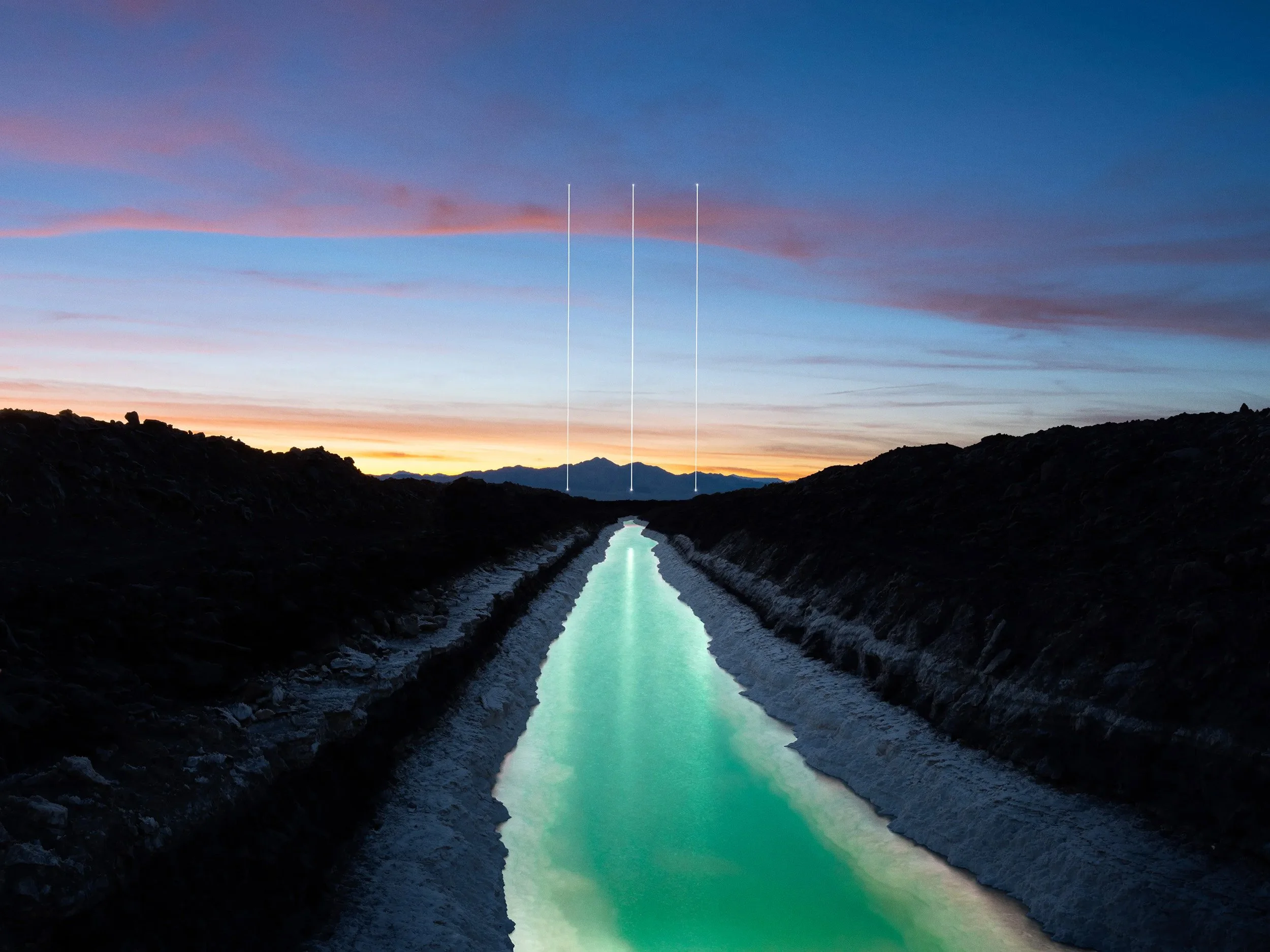
When Wu introduces light, it’s shaped in direct relation to what’s already there.
Once observation gives way to shaping, the relationship changes. The photograph is no longer a record of what was found; it becomes a deliberate alteration of how a place is encountered. Every line of light carries intention. Every decision carries consequence. Even when the light disappears, the responsibility does not. Wu doesn’t step around that risk. He works with the understanding that intervention, however temporary, leaves a trace — one that must answer not to the image, but to the place itself.
Wu has said, “The precision is in service of evoking wonder.”
In the work, that precision never calls attention to itself. It simply leaves room for feeling to surface.
The viewer doesn’t just see a place differently. They feel the familiar become unfamiliar, then recognizable again—charged by a new kind of attention.
The images don’t deliver answers.
They create a condition of attention.
Time stretches. Attention slows. The imagination activates—not to escape the world, but to enter it more fully. When a place is experienced this way, not consumed or captured but stayed with, it becomes harder to treat it carelessly.
Wu doesn’t resolve the tension between revelation and intrusion.
He works inside it.
The night holds those questions without answering them.
And so does the work.
Staying Close to the Core
Some projects arrive quickly.
Others take years to resolve.
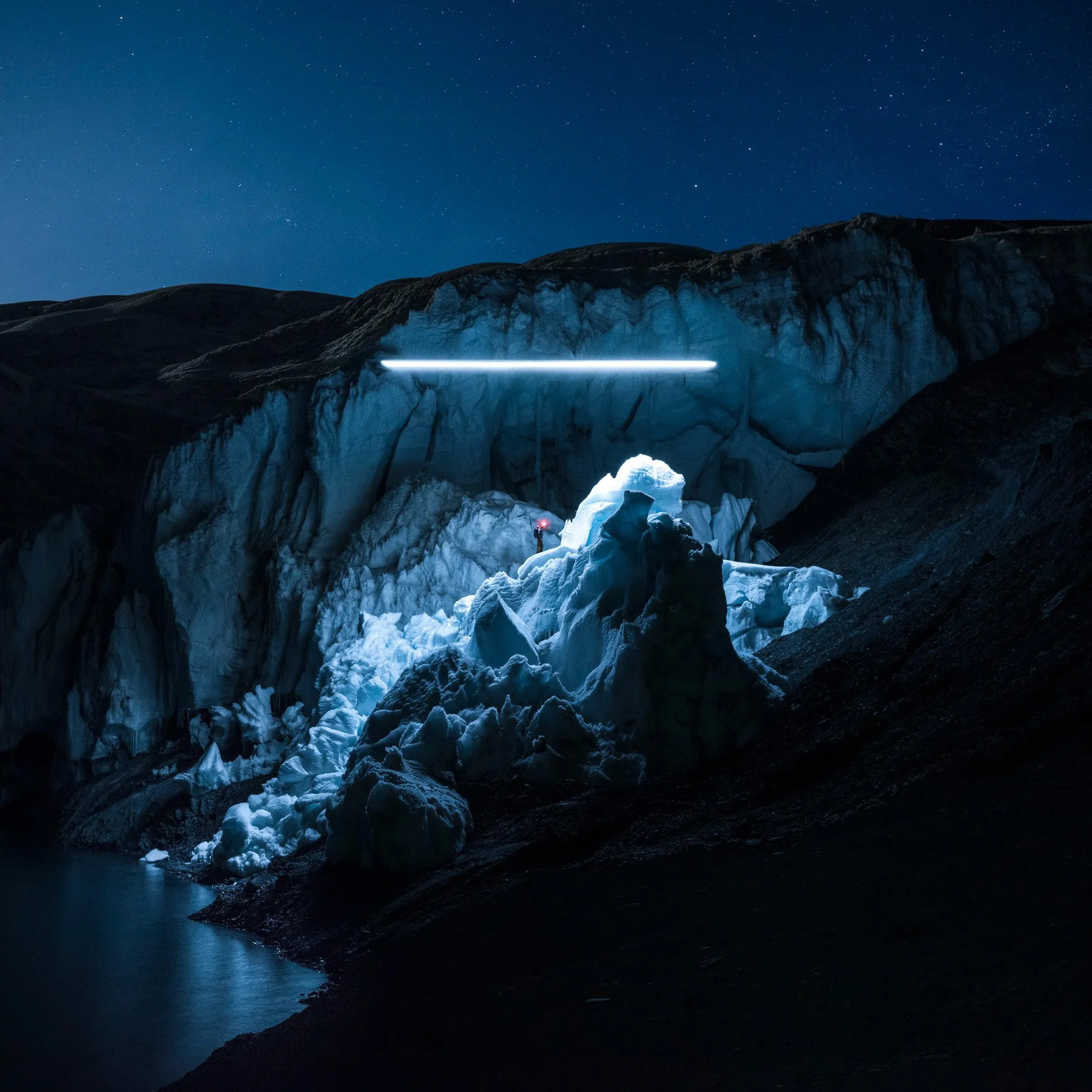
SIREN was the latter.
Wu spent nearly three years working toward it, moving through repeated experiments and technical dead ends before anything held. Progress came slowly because the question at its center needed to be lived with before it could take shape.
If the pressure had been to outpace what came before, he says, SIREN would have been abandoned early on. That impulse—to keep moving forward, to keep producing—is familiar once recognition arrives. It’s also where work begins to drift.
Instead, Wu stayed with the question that mattered most to him:
how can light feel more dimensional?
Staying close to that core sometimes means stepping away from production altogether. Wu talks about going out into these environments without any intention to make photographs—to experience a place, to be present in it, to remember why he was drawn here in the first place.
When the work begins to feel like a career rather than an exploration, that sensation becomes a signal to pause.
The obsession hasn’t changed.
The sense of wonder hasn’t dimmed.
He traces it back to childhood—poring over images of distant places, drawn to a sense of wonder long before he had words for it.
Over time, the work has become more than a practice.
It has become a way of being in the world.
Precision matters. Discipline matters. Neither exists for its own sake. They are tools used to protect something quieter and more fragile: the ability to remain open, attentive, and moved.
Once that state is entered, it doesn’t just shape how the work is made — it shapes what the work is willing to say.
Presence, Then Performance
Interpretation changes everything. The moment you stop recording and start directing, you’re no longer just seeing. You’re speaking. And that’s where the work either gains life, or reveals itself as decoration.
Interpretation carries life when performance follows presence — not the other way around.
Once interpretation enters the work, it becomes easy to mistake precision for meaning.
Rick Rubin writes that ideas exist independently — that they move through the world like signals, searching for someone ready to receive them. When I asked Reuben about this, his response wasn’t theoretical. It was lived.
“I’ve always felt that ideas are out there, almost like signals, and we’re just the ones tuning in. So when I read that part of Rick Rubin’s book, it felt less like a revelation and more like someone putting into words something I’d already been living with for a long time.”
What follows that tuning-in is not inspiration, but responsibility. Availability alone doesn’t carry an idea forward. Commitment does. Wu has spoken about moments when he waited too long, only to see something eerily adjacent emerge elsewhere — not as theft, but as inevitability. The idea wanted to exist, and it found someone willing to meet it with resolve.
This is where authorship becomes real. Not as ownership, but as follow-through. The work isn’t proven by the novelty of the idea. It’s proven by the depth of presence behind the choices that shape it.
Wu is clear-eyed about how much of his visual territory was, in theory, accessible to many. Drones, light, landscapes, long exposure — none of these belong to him alone. What distinguishes the work is not access, but articulation. The way those elements are held together. The patience to stay with a question until it earns its form.
“But the specific way it’s unfolded for me is tied to my personal history, the places I’m drawn to, my obsessions and limitations. So in theory, yes, someone else could have arrived at a version of this aesthetic — but the exact visual language I’ve developed feels inseparable from my own path.”
Because it refuses the shallow version of artistry — the one that treats style as the destination, or technique as identity. The polish matters. The control matters. But they can’t lead. They have to serve what comes first.
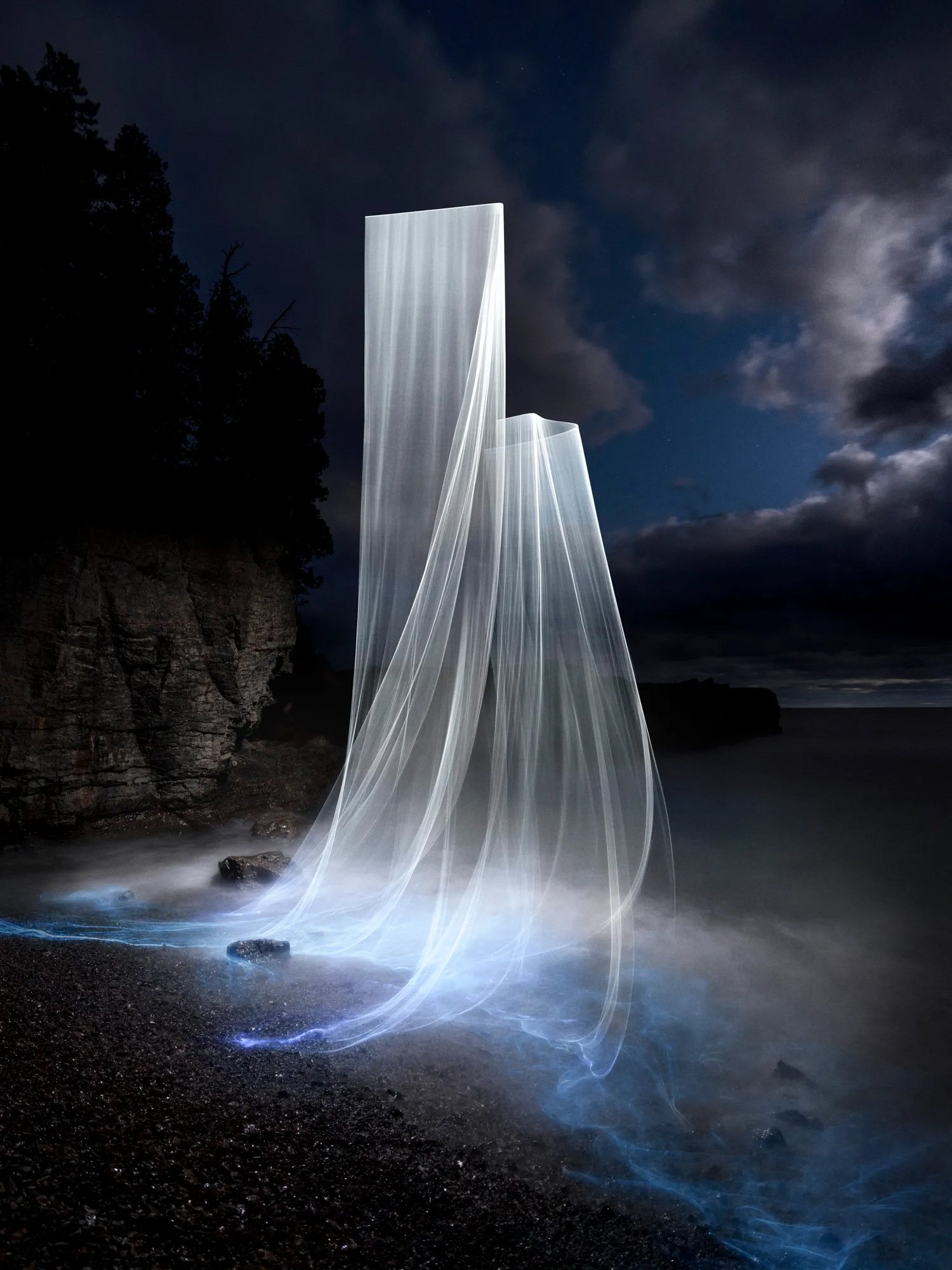
This is why Wu’s work never feels like a technical performance, even when the methods are extreme. The light may be engineered. The flight may be planned. The execution may be exacting. But the images don’t feel performed. They feel received, then shaped with care.
And that’s where interpretation stops being a stylistic move and becomes communication. Not explanation. Not imposed meaning. A lived encounter, made visible.
“The idea might be shared,” Wu says, “but the way it speaks is very particular to the person who listens to it hardest.”
Presence first. Then performance. And when that order is respected, the work carries a depth that can’t be reached through technique alone.
Work Under Permission
The approach remains the same, even as the context changes.
The work moves outward into projects where access is negotiated, time is constrained, and responsibility extends beyond the image itself.
Wu’s earliest encounter with photography came through his father’s National Geographic magazines—windows into a world that felt vast, distant, and consequential. Years later, working on a National Geographic cover story at Stonehenge, that early influence comes back into focus. Photographing one of the most documented sites on Earth meant confronting history. Expectation and familiarity were part of the terrain. Rather than overstating the scene, Wu chose restraint: carefully choreographed drone lighting that treated the stones not as monuments to be dramatized, but as forms to be re-seen. The symmetry is quiet but unmistakable. What once shaped his sense of scale now becomes a place where responsibility replaces awe, without extinguishing it.
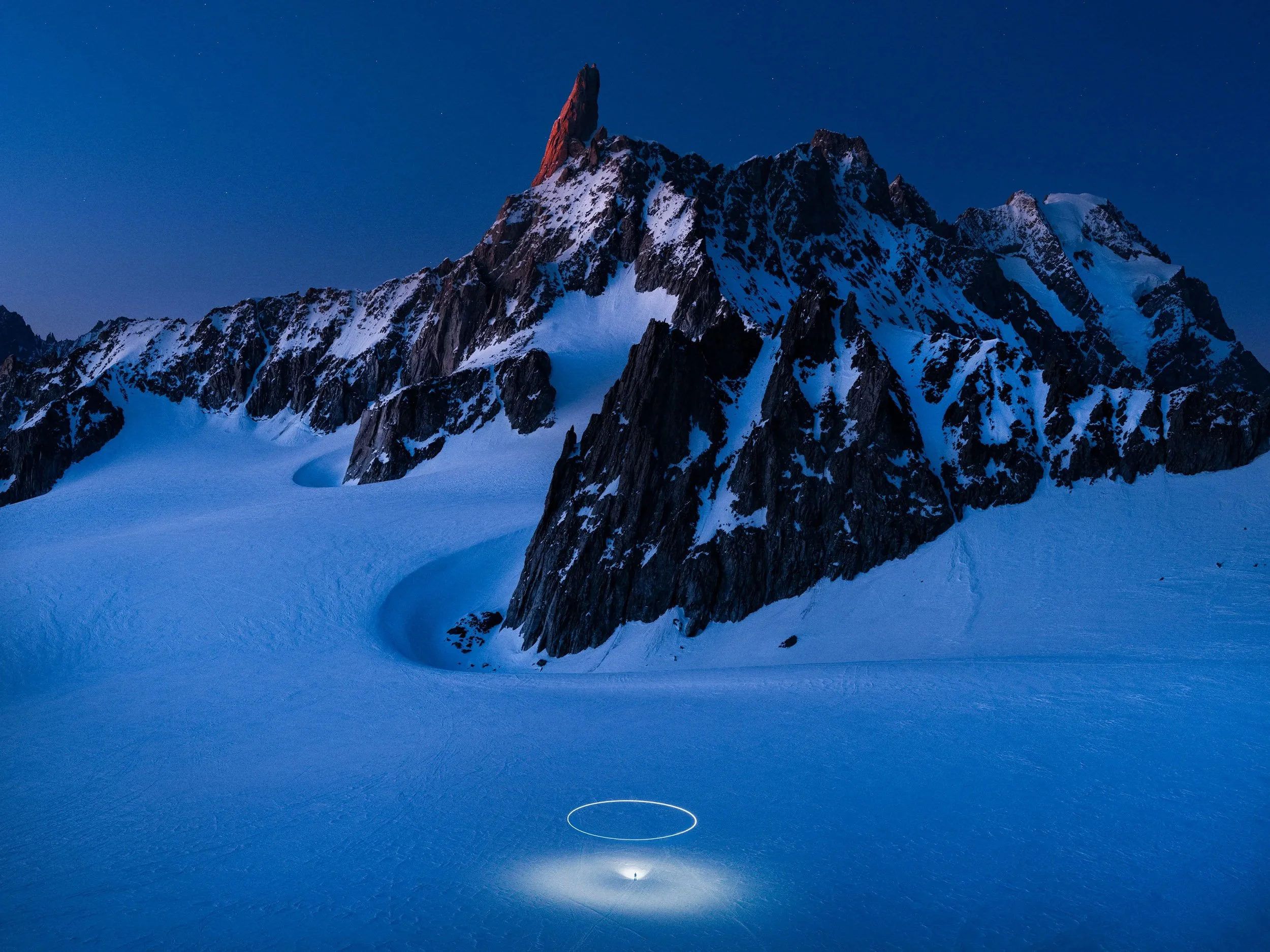
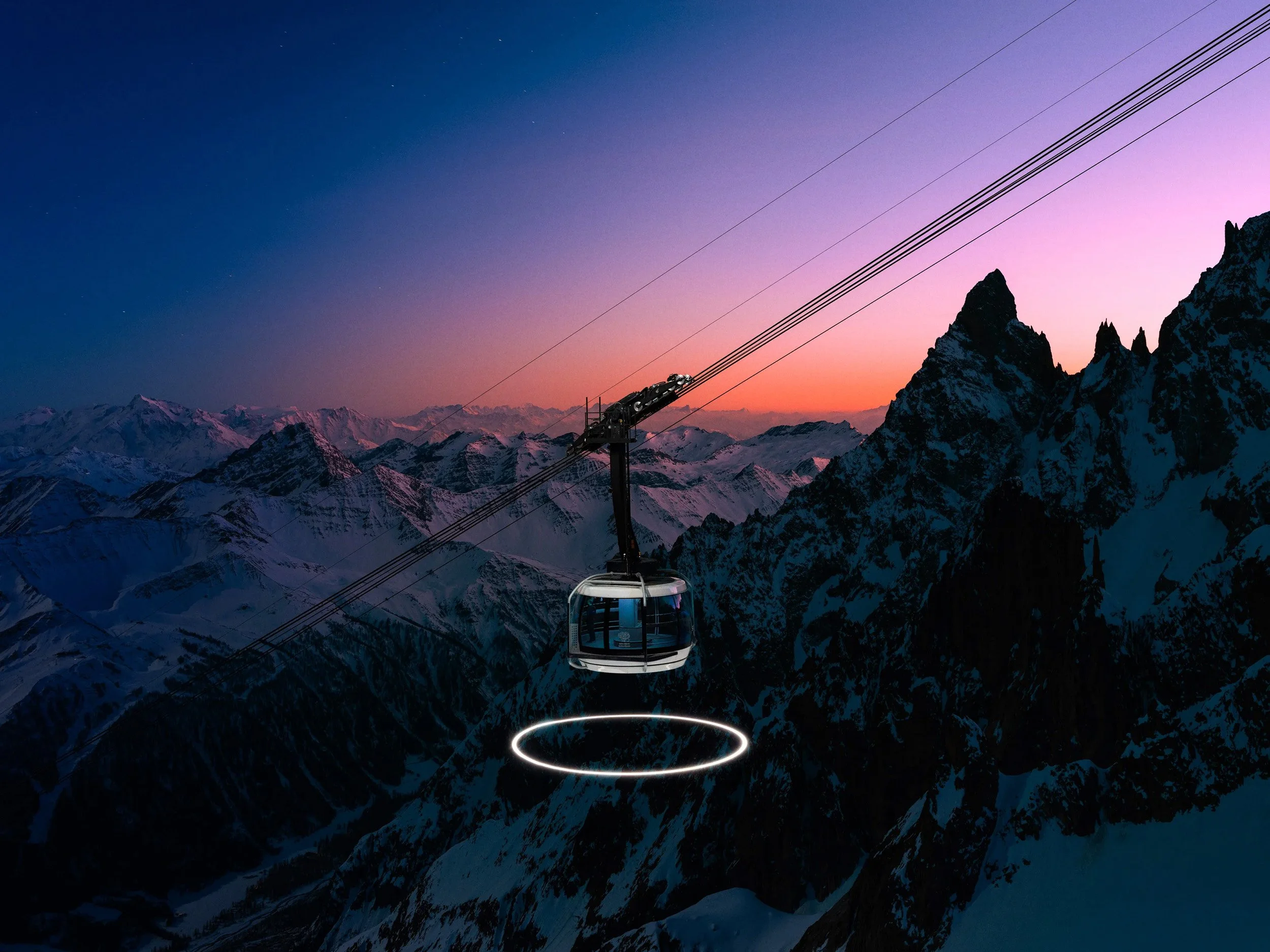
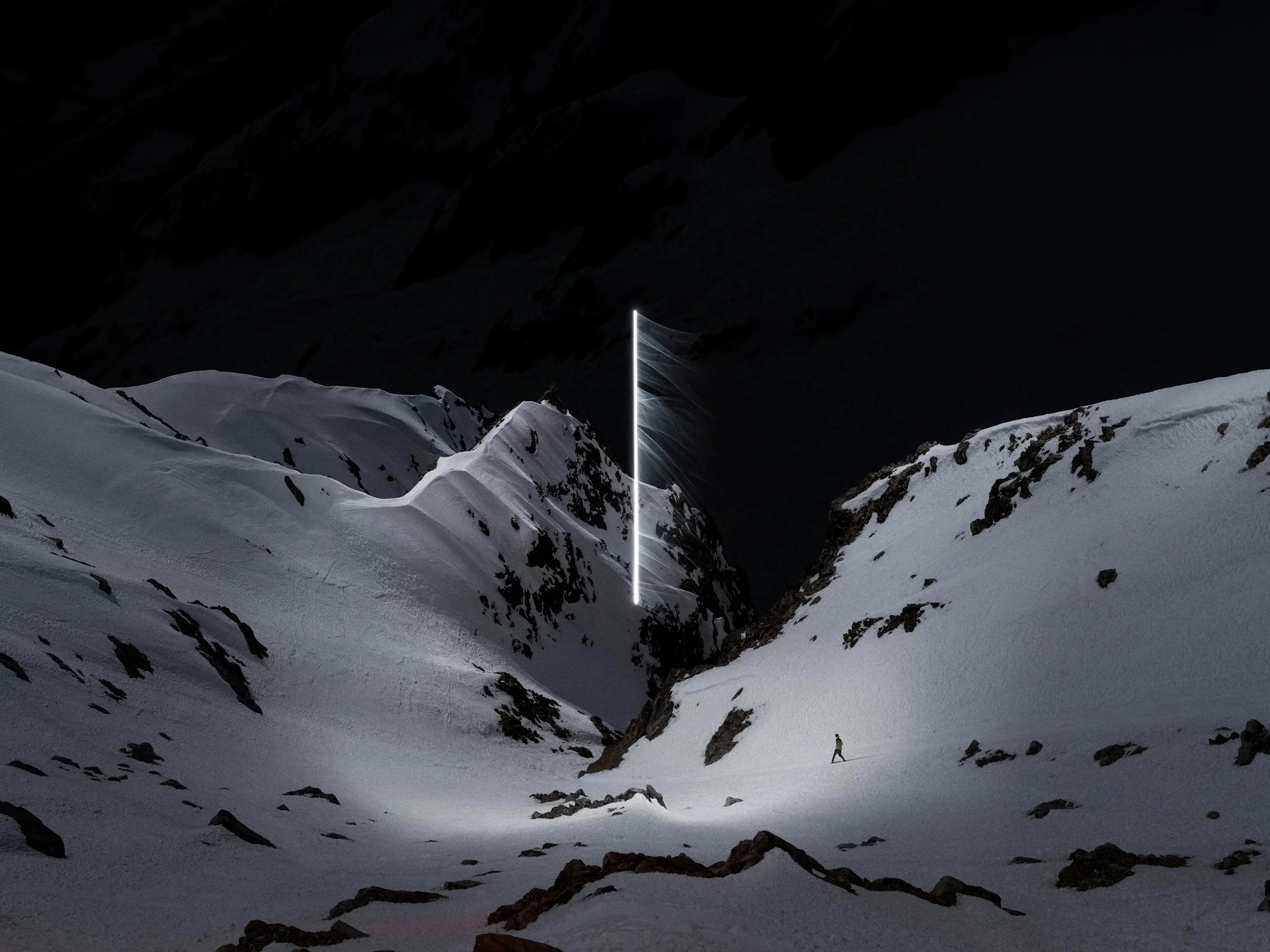
That same way of working extends into environments where landscape and infrastructure are inseparable. At 3,466 meters above sea level, Punta Helbronner rises from the Italian Alps as both an engineering achievement and a fragile presence in hostile terrain. For Skyway Monte Bianco, Wu worked across alpine golden hour, blue hour, and deep night, navigating sub-zero temperatures, limited weather windows, and the physical demands of operating at altitude.
The images unfold over hours, layered through multiple exposures, aligning celestial movement with the slow rotation of natural light across the landscape. Human figures become scale markers. Cable cars trace orbital paths. Vertical beams carve through snow and stone. Light does not overpower the mountain—it negotiates with it.
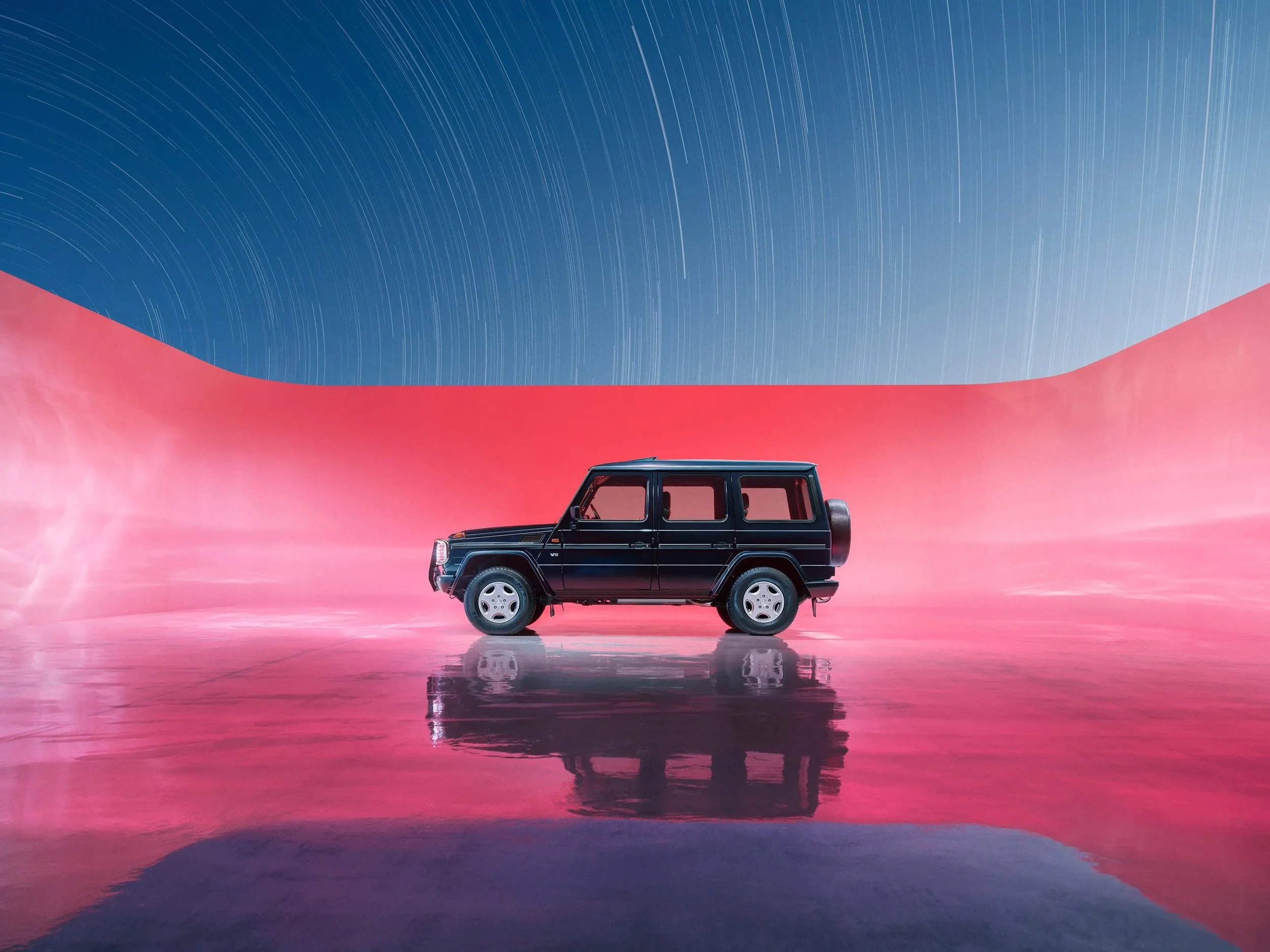
Scale shifts again in Wu’s long-term collaboration with Mercedes, including the 45 Years – G-Class calendar project in Andalusia. Traveling with eleven vehicles spanning the model’s history, Wu approached the commission not as a study of machinery, but as a continuation of his exploration of place. Working at night in remote terrain, he used aerial lighting to reframe the vehicles within environments that felt unfamiliar, almost unearthly. Each image was built through careful scouting, testing, and long hours of work, designed to hold a complete emotional arc within a single frame. The ambition is evident, but so is the discipline: light, subject, and landscape remain in constant balance.
Across these projects, the visual language stays consistent even as the contexts change. What enters the frame now are layers of coordination, expectation, and shared responsibility. The work adapts without losing clarity, maintaining its precision while absorbing the pressures of scale. Permission does not soften the gesture—it sharpens it. And it is within these conditions, where the margin for error narrows and the stakes are shared, that the work continues to evolve.
Oscillations
If permission sharpened the gesture, Oscillations removes it altogether.
At Tonlé Sap, the conditions are different.
The landscape does not hold still long enough to be entered once.
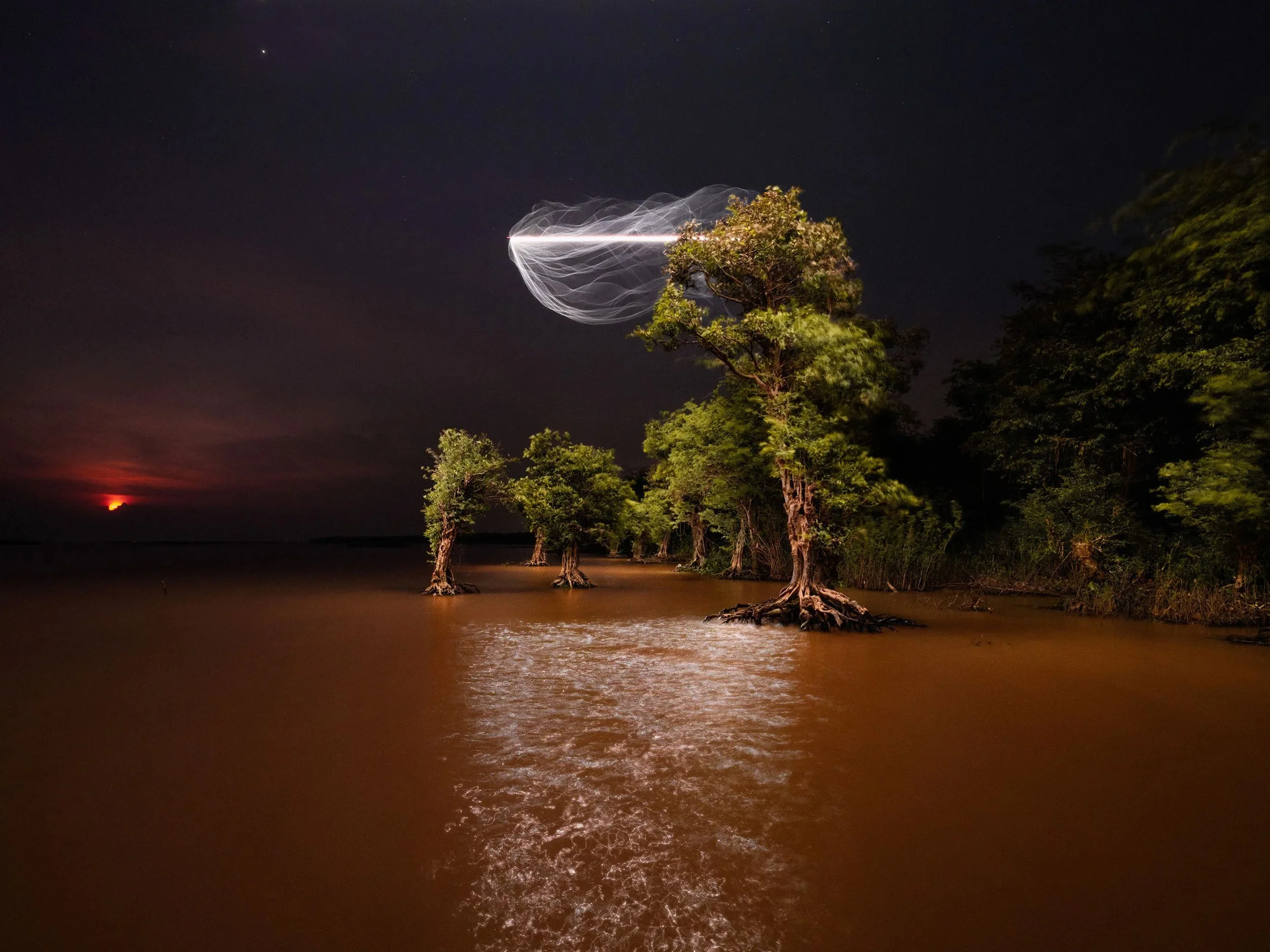
The lake sits at the center of Cambodia as a living system shaped by cycles rather than edges. Each year, water levels rise and fall by as much as ten meters, transforming forests into floodplains, shorelines into channels, and villages into floating architectures. Trees stand submerged for months. Paths disappear. What appears solid is temporary, and what seems permanent is in motion.
Wu’s work here unfolds alongside those rhythms. Created in collaboration with Conservation International and scientists studying the lake’s flood pulse, Oscillations is not an attempt to fix the landscape into a single image, but to register how it behaves over time. Wu introduces light as a responsive element— tracing currents, revealing submerged trunks, marking the presence of water where ground once was. The interventions are brief and deliberate, designed to exist within the system rather than impose upon it.
The techniques are familiar—long exposure, aerial lighting, light painting—but their function shifts. Wu’s use of light no longer announces arrival. It listens. It follows the contours of trees shaped by repeated submersion, illuminates floating villages without isolating them from their surroundings, and reveals patterns that only emerge through duration. Each image carries the weight of process rather than event.
Here, the work is inseparable from collaboration. Ecological research, local knowledge, and photographic decision-making intersect. The landscape resists simplification. There is no singular vantage point, no decisive moment to claim. What matters instead is attentiveness—returning again and again, adjusting to water, weather, and movement that cannot be controlled.
In Oscillations, light becomes a way of seeing systems rather than scenes. It acknowledges fragility without aestheticizing it, and change without resolving it. The result is not a statement about the environment, but a record of relationship—one that accepts that intervention carries responsibility, and that responsibility extends beyond the frame.
Return to the Body
However far the work travels, it still begins the same way.
One person, alone, deep into the night.
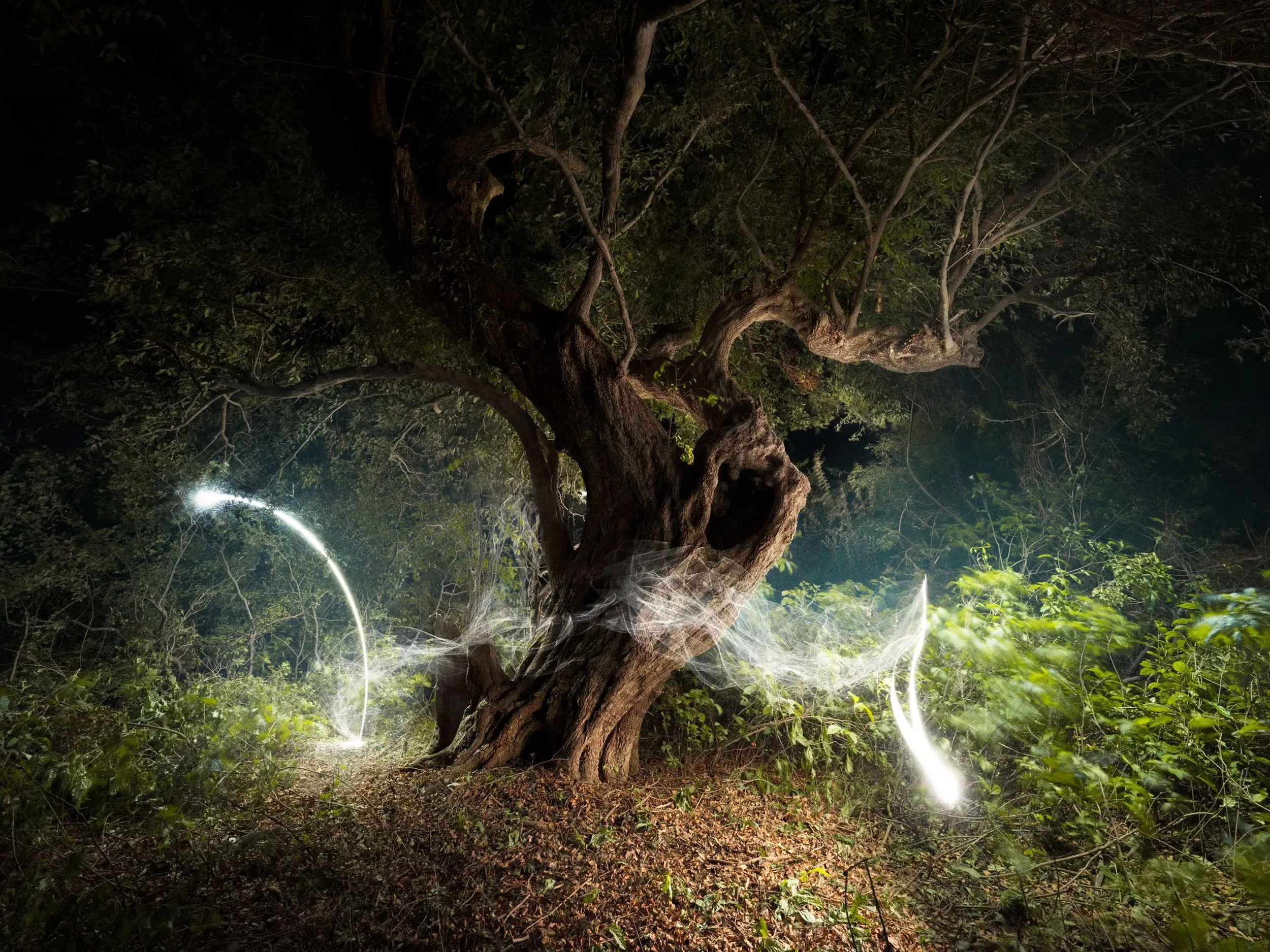
Wu returns to this condition again and again. Not as an idea, but as a lived reality: hours spent outside long after most people have gone home, when fatigue becomes part of the equation and attention has to be earned rather than assumed. There is no audience, no momentum to lean on, no certainty that the night will yield anything usable. Staying is not romantic. It’s deliberate.
“There’s a difference between taking a photo and leaving,” he says, “versus truly knowing a place by spending hours there in darkness.”
Those hours are not about productivity. They are about staying long enough for the mind to quiet and for awareness to shift. Wu describes it as a form of meditation — a state where effort, focus, and patience overlap, and where the work is shaped less by intention than by sustained presence. The place is no longer something he passes through. It becomes something he inhabits.
What follows him afterward is not just an image.
“Part of my mind stays in that location even after I leave,” he says. “I’m engineering my own memories.”
There are elements of these nights he doesn’t try to translate. Standing alone at three in the morning — on ice, in desert, in water — some of it escapes language entirely. Not because it’s abstract, but because it’s lived too fully to be reduced. What matters is not naming it, but carrying it forward.
Everything that follows takes its direction from there.
Nothing is Missing
The drone lifts into the night.
At first the sound is clear and vibrational, a steady hum fixing its position in space. As it climbs, the pitch thins. The edges soften. The sound becomes harder to locate, then harder to distinguish from the night itself, until it is no longer clear whether it is still being produced.
The light arrives a moment later.
A narrow beam forms above the ground and begins to lower. It doesn’t rush. It doesn’t wander. It meets the land exactly where it does, clean and precise, leaving everything around it untouched. The darkness holds its shape. Nothing else is revealed.
The light remains long enough to be fully seen.
Then it is gone.
The beam persists as an afterimage — no longer on the ground, but burned into perception itself, as exact as it was moments before. The night continues unchanged. Wind moves. Distance holds. The world remains.
And yet something is unmistakably present.
Sound has passed into listening.
Light has passed into seeing.
What initiated the moment is gone, but the awareness it awakened is not.
Nothing is missing.
Reuben Wu
Reuben Wu is a multidisciplinary artist whose work uses light and long exposure to reimagine familiar landscapes. His approach to aerial lighting has helped shape a distinct visual language in contemporary landscape photography.
His work is held in major museum collections, including the Guggenheim Museum and the Museum of Modern Art.
Website: reubenwu.com
Instagram: @reuben
All images copyright © Reuben Wu. Used with permission.