THE VALUE OF THE PHOTOGRAPHIC PROCESS IN AN AI-FORWARD WORLD
There’s no avoiding it anymore: large parts of photography are about to change, and change quickly. In many areas of the industry—commercial advertising, product work, food photography, high-volume editorial—the final image is the product. Speed, efficiency, and repeatability matter more than presence or experience. In those spaces, AI isn’t a philosophical question so much as a practical disruption, and it’s hard to imagine that many of those workflows won’t be fundamentally altered.
I can’t really speak to that world. It isn’t my practice, and it never has been.
What I can speak to is photography as a long-term, process-driven practice—particularly fine art landscape work. In this kind of work, the final image matters deeply, but it has never been the only source of value. From that perspective, the current moment feels less like a threat and more like a clarification.
AI is extraordinarily good at producing outcomes. What it cannot replace is experience.
For photographers who stay close to the process, the work has always asked for something more than results. It asks for time, for attention, for a willingness to be physically present in a place and to return to it without guarantees. It requires patience rather than efficiency, and engagement rather than control. Those qualities aren’t incidental to the work; they are foundational to it.
Over time, photography trains the eye. You learn to see light, form, rhythm, and space more clearly. You begin to notice how scenes organize themselves when you slow down enough to let them settle. But if you stay with the practice long enough, something subtler begins to happen alongside that external refinement.
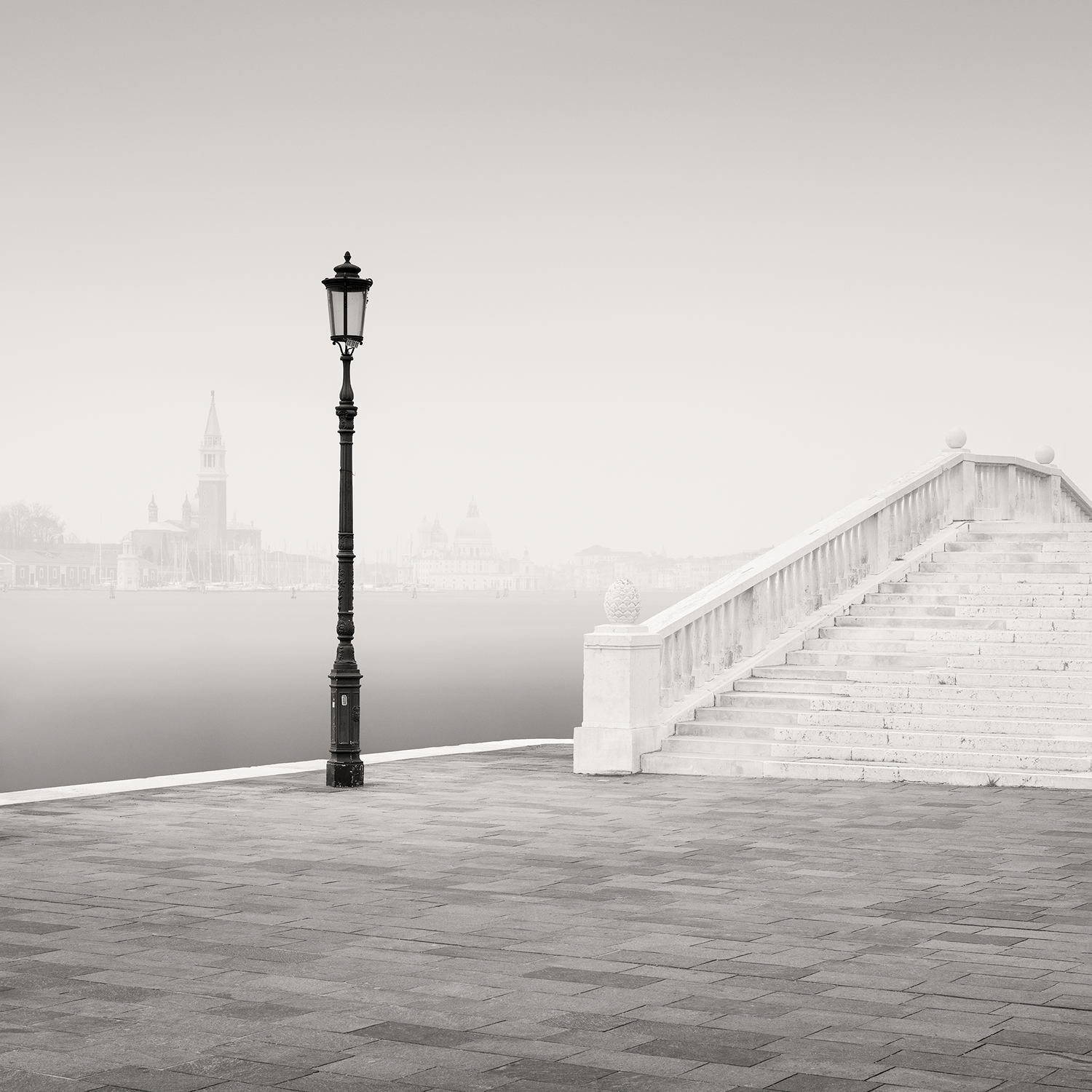
The act of looking turns inward. The image above comes from Venice, a place that rewards wandering without a plan—getting lost, returning to the same spots, and letting small elements quietly arrange themselves through sustained attention rather than force.
Returning to the same places again and again makes this inward turn unavoidable. For me, that’s been especially true along the west side of Maui, working with the kiawe trees—places I’ve photographed hundreds of times over more than two decades. Some trees remain for years. Others have been taken out by storms and have disappeared entirely. The light shifts. The wind moves through and then passes. And when a place is no longer carried by the excitement of something new, you begin to notice different things: impatience when nothing seems to be happening, restlessness when conditions don’t immediately align, resistance when the work asks you to stay longer than you planned.
Photography becomes a quiet mirror.
Learning to see more clearly isn’t just about what’s in front of the camera; it’s also about recognizing how you’re showing up while you’re there. Are you rushing toward an outcome? Are you distracted by expectation? Are you open, or already deciding what the image should be? Over time, the process sharpens both kinds of observation—the external and the internal—and that dual awareness is something no automated system can replicate.
This is where much of the “photography is dead” conversation misses the point. If photography were only about generating compelling images, automation would eventually win. But for photographers who are deeply engaged in the process, the image has never been the only measure of value. The value also lives in what sustained attention does to the way you see, think, and relate to the world.
In speaking with Reuben Wu for an upcoming feature, this same idea surfaced naturally. He spoke about how the work that matters most to him doesn’t come from chasing outcomes, but from preparation, presence, and time spent in a place—allowing something to reveal itself rather than forcing it into existence. That orientation isn’t nostalgic; it’s fundamental.
At a certain point, photography stops being about “taking pictures” and starts becoming about making them. That shift isn’t technical. It’s perceptual. The questions change. Instead of asking how to get a shot, photographers begin asking what they’re responding to, what feels essential, and what they want to express. Those questions only arise through process, and they can’t be prompted or accelerated.
This is also what I see repeatedly in workshops, regardless of location or experience level. People often arrive focused on improving their images, which makes sense. But the deeper change tends to happen elsewhere. As the pace slows and attention sharpens, something internal clicks. Photography begins to feel less like acquisition and more like expression. Less like collecting and more like shaping. That shift is subtle, but it’s often the moment when the work starts to matter in a different way.
If photography were only about outcomes, many people would have walked away long ago. The reason they stay—especially in an age where images are everywhere—is because the process offers something increasingly rare: a way of being in the world that rewards patience, attentiveness, and presence. It asks us to look more closely, not only at the landscape in front of us, but at the ways we move through the world while we’re looking.
That value doesn’t disappear in an AI-forward future. If anything, it becomes easier to recognize. Images may be endlessly generated, but experience still has to be lived—and it’s there, in that lived experience, that photography continues to do its real work.
This approach to photography is something I practice and teach through private workshops in Maui, as well as destination experiences in places like San Francisco, Venice, and Tokyo. More information can be found on the Workshops page.

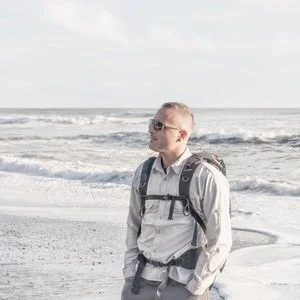
Hi, I’m Scott Reither—fine art photographer, educator, and the founder of The Curated Landscape.
I created this space to share reflections and tools for photographers who want to go deeper—into their craft, their process, and how they connect with the world through the lens.